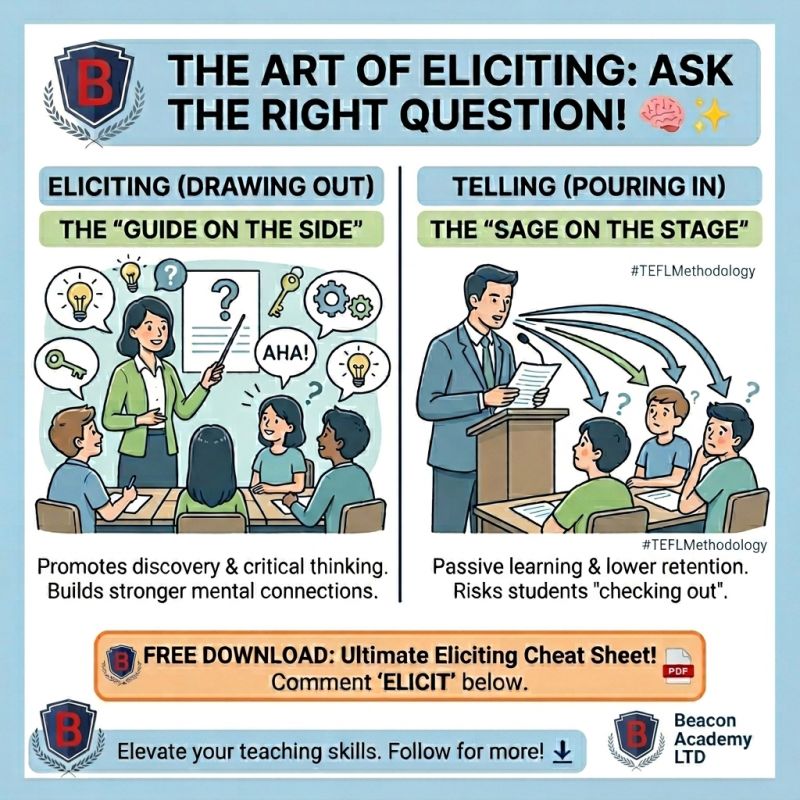
One of the hardest shifts for a new teacher to make is moving from the “Sage on the Stage” (telling) to the “Guide on the Side” (eliciting).
It’s tempting to simply give a definition or explain a grammar rule. It’s faster, right? But there’s a biological catch: The human brain is wired to forget information it didn’t have to work for.
What is Eliciting?
Eliciting is the technique of drawing information out of your students rather than pouring it into them. It assumes that students often know more than they think they do, or that they can use logic to figure it out.
Why it’s a Game-Changer:
1. Active Retrieval: When a student “discovers” a word or rule, it creates stronger neural pathways. They own that knowledge.
2. Diagnostic Power: Eliciting tells you exactly what they already know. If you “tell” them something they already knew, you’ve wasted five minutes and bored your class.
3. Reduces TTT: It naturally lowers Teacher Talk Time and increases Student Talk Time (STT).
How to Stop ‘Telling’ and Start ‘Eliciting’:
1. Use Visuals/Realize: Instead of saying “A hammer is a tool for nails,” show a picture and ask: “What is this? What do we do with it? Is it for cutting? No? For…?”
2. The ‘Mime’ Trick: Need the word “exhausted”? Don’t define it. Mime being very tired, wiped your brow, and ask: “I’m not just tired, I’m 100% tired. I am…?”
3. Context Building: Instead of giving the rule for Used To, tell a story about your life ten years ago vs. now. Ask: “Do I do this now? No. Did I do it before? Yes. Many times? Yes.”
* The Goal: Every time you are about to give an explanation, stop and ask yourself: “Is there a question I could ask that would lead them to this answer?”
🎁 FREE RESOURCE: The Ultimate Eliciting Cheat Sheet
Struggling to find the right questions for complex grammar? We’ve created a Cheat Sheet of Eliciting Prompts for the 10 most common ESL grammar points and vocabulary sets.
To get your copy:
Follow our page for your daily dose of ELT mastery.
Comment “ELICIT” below.
We’ll send the PDF directly to your LinkedIn inbox! 📩
hashtag#TEFLMethodology hashtag#Eliciting hashtag#ActiveLearning hashtag#TeacherTraining hashtag#ELT hashtag#Pedagogy hashtag#EnglishTeachers hashtag#BeaconAcademyLTD hashtag#ClassroomTips